FAITH MATTERS: Some Common Elements among the World’s Religions

faith_matters_imgIn the last blog post, we looked at what religious faith is and the variety of religions we find in the world. In this post, I want to explore some commonalities among religions. Religions tend to use the similar vehicles to transmit their beliefs and practices. These vehicles are scripture, myth, creed, liturgy, and theology.

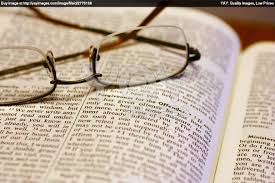
Scripture: The word scripture comes from the Latin scriptura, the act of writing. So the scriptures of a religion generally refers to the official or holy writings of a religion. Scriptures are vehicles for the transmission of a religion in that they contain the stories, myths, rules, and liturgies of a religious community. The book of Scripture for Christianity is the Bible, which is divided into two sections, the Hebrew Scriptures or Old Testament and the New Testament.

Myth: Myth is one of the most misunderstood and misused words in our religious vocabulary. All too often people think that a myth is a fable, a fairy tale, or a fictional story. But a myth is a great deal more than that. Myths are fictional stories, but they are stories that are trying to explain a major religious concept. Myths are true in that, while the details of the story are not scientifically or historically accurate, they are conveying an important religious truth, usually a truth about human nature or the relationship between God and humanity. For example, in the Greek myth of Pandora’s Box, Zeus gives Pandora a box and tells her not to open it. Pandora is overwhelmed by the temptation and opens the box, letting loose all of the bad things in the world: envy, hatred, etc. However, just before everything can escape from the box, Pandora slams it shut keeping hope safe in the box. This myth is not historically or scientifically accurate, but it does try to explain, in terms that regular people can understand, how all those bad things came into the world and why hope is more important and more powerful than the bad. Let us now look at a myth from Christianity. We are all familiar with the story of Adam and Eve and their expulsion from the Garden of Eden. In the story, Adam and Eve, the first people to be created by God, are told not to eat from the tree of the knowledge of good and evil. Eve, however, is tempted and eats; she then convinces Adam to eat from the tree as well. God punishes their behavior by expelling them from the Garden of Eden and by sentencing them to labor throughout their lives. What is important about this myth is not whether or not Adam, Eve, the Garden, and the tree really existed. What is important is that this story tries to explain to regular people why there is sin in the world, why people must continue to work really hard to survive, and why there are rules and punishments. These religious truths are the point of this myth, not the details that were used to get those religious truths across.

Creed: The word creed comes from the Latin word credo, which means “I believe”. A creed, then, is a statement of belief. It is an explanation or recitation of the important beliefs of a religion. The creeds of Christianity are long but careful summaries of what all Christians believe. The Apostle’s Creed was the first one to be written and the Nicene Creed is an expansion of it. Both of these creeds are very ancient; the Nicene Creed was written at the Council of Nicea in the early 4th century.

Liturgy: A liturgy is the formal and ritualized worship of a religion. Liturgies are made up of a number of ritual actions and prayers that are done in the same or a similar way every time. Liturgies allow the community to come together to celebrate their religious faith and to remind themselves of the fundamental truths of their faith. Think of the Liturgy of the Word, which is the first part of the Mass in Catholicism. At a Mass on a Sunday, the Liturgy of the Word is almost always made up of a reading from the Hebrew Scriptures, a Psalm, a reading from one of the letters in the New Testament, a reading from one of the four Gospels, a homily or sermon, a recitation of the creed, and a series of community prayers. This format is the same in every Catholic Church on every Sunday of the year. It is a liturgy.

Theology: The word theology comes from two Greek words, theos (god) and logos (word or study). Therefore, the word theology means words about or study of God. Theology is not just something that is done by professionals; anyone who thinks, talks, and studies about God is a theologian. Theology is the attempt by the people of a particular religion to understand their faith better and to explain it in a way that helps others deepen their faith. In Christianity, theology means trying to understand who God is, how God is related to human beings, and what God wants human beings to do.
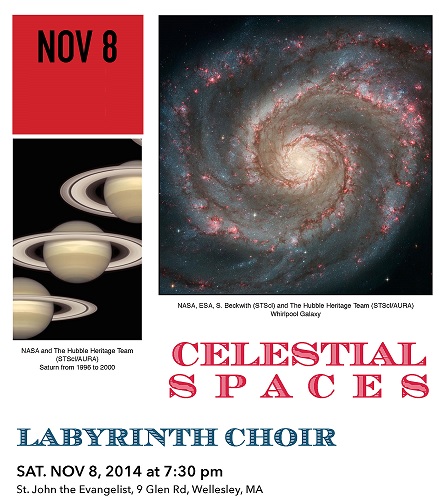
Labyrinth Choir Concert at St. John: Saturday, November 8 at 7:30pm

Labyrinth_Celestial SpacesSongs of the heavens, stars and night –

Complimentary tickets are available for St. John parishioners in the bulletin.

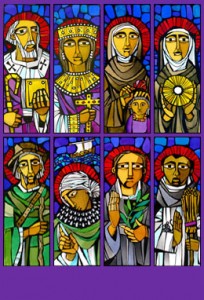
Saturday, November 1: All Saints Day

The Feast of All Saints Day, which is celebrated on

November 1, falls on a Saturday in 2014 and
therefore is not a holy day of obligation. Mass will
be celebrated at the regular times of 7:00 a.m. and 5:00 p.m.

First Sunday Choir

music_choirEveryone is welcome to join our next First Sunday Choir on Sunday, November 2. No auditions required – just the desire to experience the joy of singing. Music for November’s First Sunday includes the gentle beautiful “Sanctus” from Fauré’s Requiem and the African American spiritual “Stealing Away”.  The First Sunday Choir sprouted up a couple of years ago with the sole aim of bringing together as many singers as possible at one time. With a designated day (First Sunday), singers budgeted their time and invested a small window of their time and energy into the joy of singing. The “one day, one rehearsal, one Mass” mantra came about. The thought was to keep commitment as snug as possible. This approach worked fairly well except that some singers wished to have more rehearsal time, devote more time to learning music resulting in boosted confidence. To that end we have added the Thursday evening rehearsal—the Thursday before the first Sunday. Below is the schedule of the Thursday Rehearsals and the First Sundays.

Thursday Night Rehearsals
(7:30 – 9:00pm)
October 30
December 4
January 1 (tentative)
January 29
February 26
April 2 (Holy Thursday, TBA)
April 30
June 4
First Sundays
(10:00am-12:00pm)
November 2
December 7
January 4
February 1
March 1
April 5 (Easter)
May 3
June 7

October 26: Upcoming AFFC Events

Tuesday, October 28, 5:30 p.m.
LIFE MATTERS: REFLECTIONS ON THE SYNOD ON THE FAMILY
Lecture by James Bretzke, S.J.
Boston College Theology and Ministry Library Auditorium, Brighton Campus Free of charge.
This talk reflects on the recently concluded Extraordinary Synod on the Family called by Pope Francis, and discusses the major themes that emerged from that October meeting of bishops and Church leaders from around the world. Particular attention will also be given to the input offered by the American bishops, especially in light of the perennial concerns voiced about the array of life matters and family values that intersect with political choices Catholic voters must make in the election.

Tuesday, November 4, 6:30 p.m.
EVENING FOR WOMEN

St. John Church/Social Hall, Moderator: Sr. Evelyn Ronan
Cardinal Carlo Martini once described grace as knowing that “you have been loved for a very long time.” Through prayer, reflection and sharing, this year’s
program will take us deeply into this truth, that we may help each other embrace its reality and be transformed. Includes a fabulous ‘Pot Luck’; please bring your
favorite Fall recipe. All Welcome!

November 13, 7:30 p.m.
ST. JOHN’S BOOK DISCUSSION GROUP: THE SYNOD OF BISHOPS ON THE FAMILY
St. John Parish Center
All members of the parish are invited to the November 13 meeting of the Parish Book Discussion Group. The topic will be “The Synod of Bishops on the Family”, and our discussion will focus on both the process and structure of decision-making in the Vatican and the substance of the many issues discussed (or that should have been discussed!)  There has been extensive press coverage of the October meeting in Rome; thus we are asking participants in the November 13 meeting to read as much as possible and come prepared to express your conclusions, opinions, reservations, hopes and expectations. These are obviously important challenges in the life of our Church and we all have a serious responsibility to become as informed as possible. One new and wonderful source of information is CRUX, the website of Catholic news sponsored by The Boston Globe.  For further information and to give us an idea of how many will attend, please contact John Stewart (617.969.0950) or Peter Mongeau.

AFFC LogoSt. John’s Adult Faith Formation Commission
Email: AFFC@stjohnwellesley.org

October 26: News from Religious Education

Religious-Education-Contemporary_SMALLThis Week: Sunday, October 26
Grade 2 Enrollment Mass 9:00 a.m.
Grades 1 – 6 Class 10:00 – 10:45 a.m.
Next Week: Sunday, November 2
Grades 1 – 6 Class 10:00 – 10:45 a.m.
Grades 7, 8 Class 6:00 – 7:00 p.m.
Friends for Good 7:00 – 8:00 p.m.
Grade 9 Friends for Good 6:00 – 7:00 p.m.
Class 7:00 – 8:00 p.m.
Grade 10 Class 7:00 – 8:00 p.m.
Wednesday, November 5
Grades 1- 6 Class 3:30 – 4:45 p.m.

A full calendar of all events is available on the Religious Education page.

If you have any questions, please contact Jane Leonard, jane.leonard@stjohnwellesley.org, or Linda Messore, linda.messore@stjohnwellesley.org.

October 19: News and Resources from the AFFC

Faith Formation Web Resources

Check out these interesting and informative websites to learn more about the Catholic Church, our faith, and what is going on in the world.

  • Crux  was recently launched by the Boston Globe and features the work of John Allen (formerly Vatican correspondent for NCR). They are an English language site that seeks to cover world-wide Catholicism.
  • National Catholic Reporter is a more established Catholic weekly paper, run by lay Catholics and focusing on the Church in the U.S.
  • Catholic News Service is produced by the US Conference of Catholic Bishops and covers the worldwide Church, especially the papacy.

FAITH MATTERS

What is faith – specifically, religious faith? Read the latest post in our FAITH MATTERS blog where we begin to lay the groundwork for a longer discussion of the first person of the Trinity, God the Father.

Upcoming Faith Formation Events at Boston College

Wednesday, October 22, 4:00 p.m. 
Panel Discussion at Boston College
Presenters: Claire E. Wolfteich, Roberto Goizueta,
Colleen Griffith, and Thomas H. Groome
B.C. School of Theology and Ministry, 9 Lake Street,
Room 100, Brighton Campus
This event celebrates the publication of Invitation to Practical Theology: Catholic Voices and Visions (2014, Paulist Press), a collection of essays which promises to advance the vital conversation around practical theology, especially in Catholic circles. Free of charge and open to the public. Early registration recommended.

Friday, October 24, 10:00 a.m.-12:00 noon
Taking the Church to the Street
Presentation by Rev. Debbie Little
B.C. Gasson Hall, Rm. 100
Free of Charge.

AFFC LogoSt. John’s Adult Faith Formation Commission
Email: AFFC@stjohnwellesley.org

October 19: News from Religious Education

Religious-Education-Contemporary_SMALLThis Week: Sunday, October 19
Grades 1 – 6 Class 10:00 – 10:45 a.m.
Grades 7, 8 Class 6:00 – 7:00 p.m.
Friends for Good 7:00 – 8:00 p.m.
Grade 9 Class 7:00 – 8:00 p.m.
Grade 10 Enrollment Mass 5:00 p.m.
Friends for Good 6:00 – 7:00 p.m.
Class 7:00 – 8:00 p.m.
Wednesday, October 22
Grades 1- 6 Class 3:30 – 4:45 p.m.
Next Week: Sunday, October 26
Grade 2 Enrollment Mass 9:00 a.m.
Grades 1 – 6 Class 10:00 – 10:45 a.m.

A full calendar of all events is available on the Religious Education page.

If you have any questions, please contact Jane Leonard, jane.leonard@stjohnwellesley.org, or Linda Messore, linda.messore@stjohnwellesley.org.

FAITH MATTERS: What is Faith?

faithOver the next few weeks, we will begin to take a look at the first person of the Trinity, God the Father.  But before we can start that, I would like to lay some groundwork – some preliminary ideas that help us when we start to think more specifically about God.

A good synonym for faith is trust.  Religious faith, then, is trust in a god.  For Christians, religious faith means trust in our God, the god of Christianity.  Faith in a god or gods is the foundation of most of the major religions of the world.  In general, religious faith or trust means that the individual recognizes his or her powerlessness and createdness in the face of the supernatural.  In other words, the believer understands the god or gods to be in control of reality as creators of reality and the ones who sustain or keep it going.

Based on this definition of faith, we can begin to understand what a religion is.  In the broadest sense of the word, a religion is a community of people who share a religious faith in a god or a specific group of gods.  For example, Christianity is the community of people who profess their faith in the Triune God (the Trinity).  As you can see, a religion requires a group of people.  In addition, the practice of a religion takes place within the community.  While all religions do emphasize the internal faith, devotion, and prayer life of the individual, all religions are also defined by the outward signs of faith, devotion, and prayer of the community as a whole.  In Christianity, all Christians, no matter what their specific denomination, gather to worship God on Sundays.

Some of the religions of the world are monotheistic.  Monotheistic religions believe in and worship only one God.  There have been several monotheistic religions in history; the three most common monotheistic religions today are Judaism, Christianity, and Islam.  These three monotheistic religions are related historically and share many similar beliefs.  Polytheistic religions are much more common in the history of the world.  Polytheistic religions believe in and worship more than one god.  The largest polytheistic religions today are Hinduism, Shintoism, and the native religions of the indigenous populations of the Americas, Africa, and Australia.  The ancient Greeks, Romans, and Egyptians, among many other civilizations, were also polytheistic.  Finally, there are several religions that do not fit either of these two categories.  They are called religious philosophies because they tend to focus more on the proper behavior for this world or on the individual’s development of their own social or meditative skills.  Buddhism is a religion that is not at all concerned about the gods, although they do recognize the existence of gods; Buddhists focus on meditation to clear the mind and reach enlightenment.  Confucianism is another religious philosophy.  Again, Confucianism doesn’t deny the existence of the gods, but it focuses on how an individual is supposed to live a good and proper life for the benefit of all in the community.

October 12: News and Resources from the AFFC

Faith Formation Web Resources

Check out these interesting and informative websites to learn more about the Catholic Church, our faith, and what is going on in the world.

  • Crux  was recently launched by the Boston Globe and features the work of John Allen (formerly Vatican correspondent for NCR). They are an English language site that seeks to cover world-wide Catholicism.
  • National Catholic Reporter is a more established Catholic weekly paper, run by lay Catholics and focusing on the Church in the U.S.
  • Catholic News Service is produced by the US Conference of Catholic Bishops and covers the worldwide Church, especially the papacy.

And don’t forget to check out St. John’s Faith Matters blog! We regularly post reflection on a variety of Catholic faith topics with an eye towards exploring the richness of our tradition.

Upcoming Faith Formation Events at Boston College

Wednesday, October 22, 4:00 p.m. 
Panel Discussion at Boston College
Presenters: Claire E. Wolfteich, Roberto Goizueta,
Colleen Griffith, and Thomas H. Groome
B.C. School of Theology and Ministry, 9 Lake Street,
Room 100, Brighton Campus
This event celebrates the publication of Invitation to Practical Theology: Catholic Voices and Visions (2014, Paulist Press), a collection of essays which promises to advance the vital conversation around practical theology, especially in Catholic circles. It will feature presentations by contributors Roberto Goizueta, the Margaret O’Brien Flatley Professor of Catholic Theology, B. C. Department of Theology; Colleen Griffith STM Associate Professor of the Practice of Theology and Faculty Director of Spirituality Studies; and Thomas Groome, STM Professor of Theology and Religious Education, and Chair, Department of Religious Education and Pastoral Ministry. Moderated by editor Claire Wolfteich, Associate Professor of Practical Theology and Spiritual Studies, and Co-Director of the Center for Practical Theology. Free of charge and open to the public. Early registration recommended.

Friday, October 24, 10:00 a.m.-12:00 noon
Taking the Church to the Street
Presentation by Rev. Debbie Little
B.C. Gasson Hall, Rm. 100
One day more than 20 years ago, Debbie Little looked at all the people sitting on the Boston Common park benches and thought, “The church is out here, not where buildings are necessarily, but where people are. We need to show up for it!” With this inspiration, she was moved to take the gifts of the church out to people who cannot come in to receive them—gifts which she describes as celebration, accompaniment, welcome, continuity, prayer, music, Bible study, and pastoral care. Who are these people, how do we serve them, where do we begin? Say YES to the small voice within and the leading of Pope Francis, and join Rev. Little as she shares experiences, graces, and struggles of church life on the street. “Jesus was a homeless man and so am I,” says Billy, who will join her with others to share blessings they receive from being met by church on the street. Rev. Dr. Debbie Little is founder and missioner of Ecclesia Ministries and Common Cathedral Boston. Sponsored by the School of Theology and Ministry. Free of Charge.

Thursday, October 30, 5:30 p.m.
Sacraments and Chicken Soup: Sacramental Living in a Post-Conciliar Church
Lecture by Kathleen Hughes, R.S.C.J.
B.C. Corcoran Commons, Heights Room, Chestnut Hill Campus
After identifying some key sacramental insights of Vatican II, assessing the reception of the liturgical reforms in the United States, and concluding that genuine catechesis based on a new theology of sacrament has not yet happened, this presentation will consider a fresh method of opening up the mystery of sacrament. “Mystagogy” as method invites believers to explore the intimate relationship between the liturgy and the way we live our lives, between sacraments and chicken soup. Sponsored by the School of Theology and Ministry. Free of charge.

AFFC LogoSt. John’s Adult Faith Formation Commission
Email: AFFC@stjohnwellesley.org